
AI is here.
And while none of us knows exactly where it is going, I think it’s important to keep learning enough to understand what the technology can do and imagine what it might enable.
Over the past three years, my own use of AI has continued to evolve.
I started by using chatbots almost like an extension of a search engine. Then I moved into requesting research summaries with detailed guidance. Brainstorming. Challenging ideas. Debating back and forth on topics. And, creating things together.
With each step, I’ve become more aware of both what AI can do and where my own judgment still needs to take over.
The next area I wanted to understand better was AI agents.
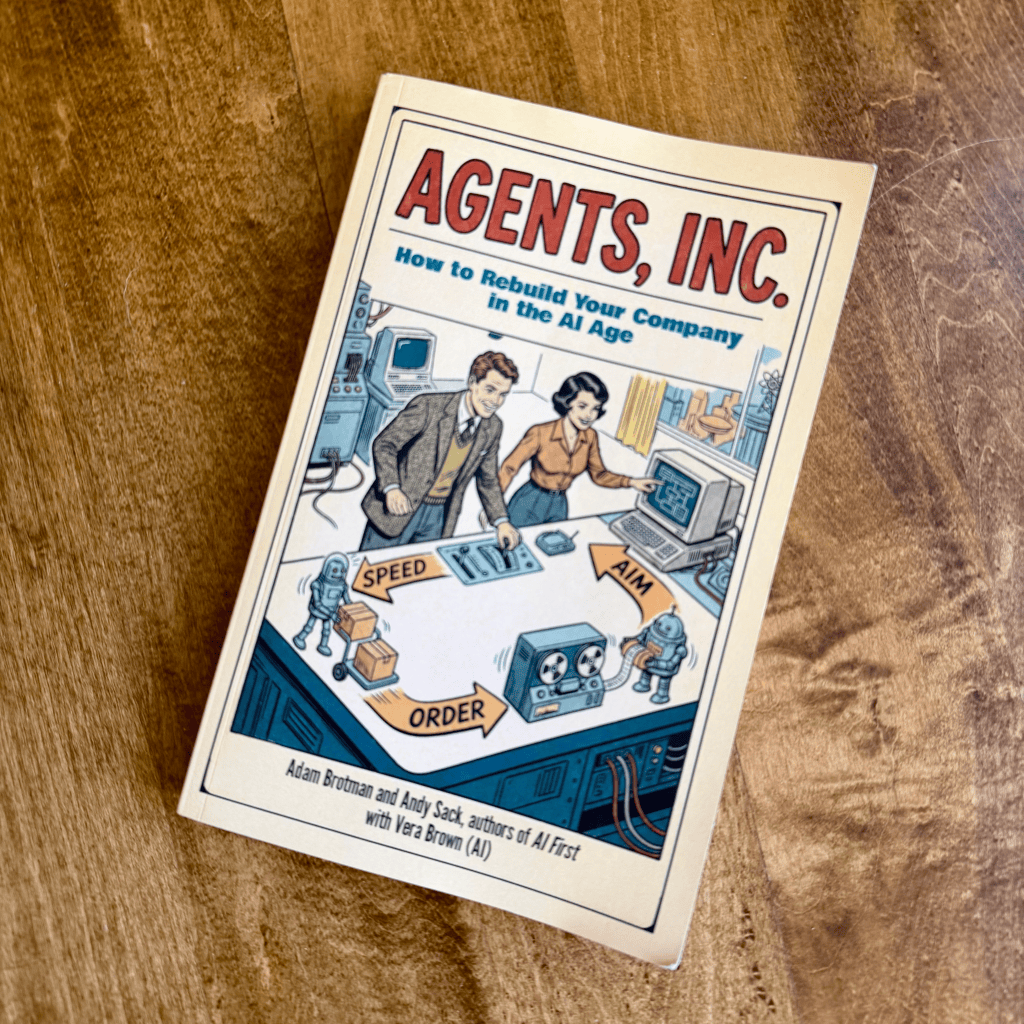
That’s what led me to Agents, Inc.
What Stood Out
One of the most useful parts of the book is simply understanding what an agent actually is.
The authors describe it this way:
“An agent is an AI system that can take a goal, plan the steps required to accomplish it, use tools, operate software, remember context, run its own checklist, verify its work, and complete the task across time.”
That definition helped me see the distinction between asking AI to help with a task and giving an AI agent responsibility for accomplishing a goal.
But Agents, Inc. isn’t really a book with three or four simple takeaways.
It is more like a combination of explanation, instruction and possibility.
The book walks through how agents work, how you can begin creating your own, and how organizations might eventually operate when employees aren’t just doing work themselves. Instead, they are also managing groups of AI workers.
That has potentially significant implications for how companies are structured.
Traditional organizational structures could begin to change as individuals and teams dramatically expand what they are capable of accomplishing.
What I found most interesting was what happened while I was reading.
I started asking myself what areas of my work would be good to hand over to an agent. The book gets creative juices flowing and imagining the possibilities.
My Perspective
For me, this book is part of a learning journey that has been happening for several years.
As my use of AI has evolved, so has my understanding of where it is valuable.
I’ve also learned not to blindly accept what AI recommends.
Sometimes its recommendation is excellent.
Sometimes my experience and judgment tell me to go in another direction.
Agents feel like another evolution in that journey.
What could an agent, or a group of agents, begin to research, monitor or execute while I focus my time on other things?
That question becomes even more interesting at the organizational level.
If individuals can manage teams of specialized AI agents, businesses may be able to expand their capabilities without expanding their organizations in the ways they traditionally have.
I don’t know exactly what that future looks like, but I want to understand enough to participate in shaping it rather than simply reacting to it.
Who Should Read It
The better question might be: Who wouldn’t I recommend this book to?
You don’t need to be a technologist or someone building AI products.
If you work, lead a team, run a business, advise organizations, or want to understand how AI could affect your career, I believe there is something here for you.
You just need to be curious about what’s becoming possible.
Your Turn
Where has your use of AI evolved over the past few years?
What work could you imagine handing off to an AI agent rather than simply asking AI to help you complete?
If agents dramatically expand what one person can accomplish, how might that change your role or that of your organization?