
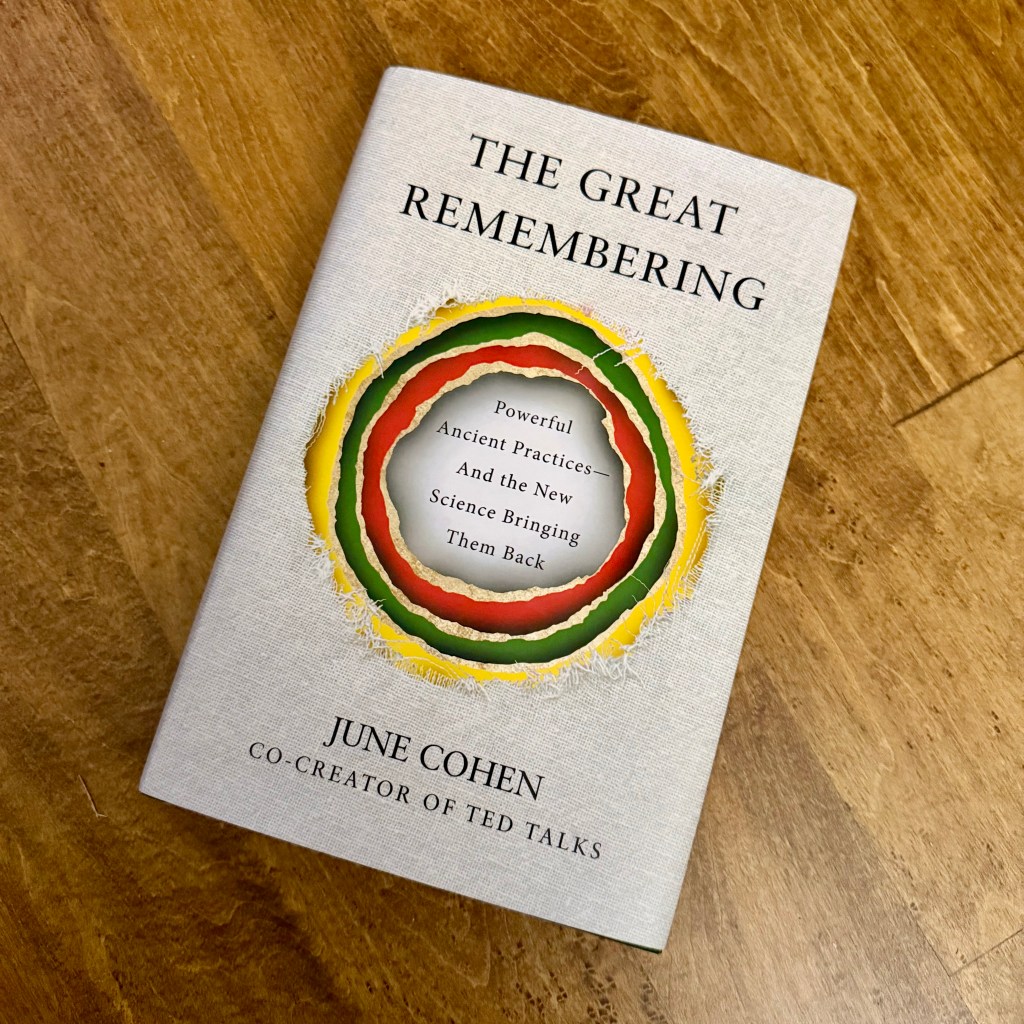
I read The Great Remembering: Powerful Ancient Practices—and the New Science Bringing Them Back by June Cohen through the Next Big Idea Club. This book, like several others I’ve reviewed, had subtitles that drew me in. I’m starting to realize the importance of good subtitles to really let you know what the essence of a book is.
In this case, I wanted to understand how ancient practices could help us today… and how science backs them up.
The premise of the book is that there are practices from ancient times that nourished us and provided a sense of community. In today’s world, many of these practices have faded away. The book reminds us of their power and suggests we work them back into our day-to-day experiences.
What Stood Out
The book explores six ancient practices: epic physical challenges, saunas and cold plunges, communal awe (festivals), psychedelic ceremonies, grieving, and the bedchamber.
I really enjoyed learning about the history and science behind these practices. Some of the connections were things I’d never heard before. One of my favorite chapters was about saunas and cold plunges. I’ve experienced both and know how good I feel afterward. Learning more about the science behind those feelings reinforced why I want to find ways to engage in these practices more often.
Another chapter that stood out was about festivals and gatherings. From small gatherings to large festivals, these shared experiences have the ability to rejuvenate us. I especially liked the concept of “collective effervescence”. The shared energy, emotional connection, and sense of unity we feel when we gather around a common purpose or activity.
The chapter on death also made an impression. Historically, death and grieving were community experiences, with people coming together to provide support. Today, especially in the United States, grieving can be a much more solitary experience. The support of others can make a huge difference as we navigate loss.
Throughout the book, I loved stories about ceremonies, gatherings, and traditions.
The sense of community comes through in every chapter.
In the conclusion, June summarizes four ideas that capture the essence:
- Your body is a pathway to your mind, your mood.
- Your health is shockingly dependent on other people, particularly our friends.
- You are deeply, entirely interdependent with nature.
- You need to connect to something larger than yourself.
My Perspective
Two things really stayed with me.
First, our mind, body, and spirit are all connected. When we feel emotions, they can show up physically. Our physical experiences can also influence how we feel mentally and emotionally.
Second, we are all connected. As social beings, our wellbeing is improved when we do things in community with others. From festivals to grieving, the process is better together.
Some of the practices covered in the book are already loosely connected to my life today, while others are things I’ve never even considered.
The book made me want to go deeper into the practices I’m already leveraging and start to consider adding more.
What I appreciated most was the reminder that we aren’t on this journey of life alone. There is wisdom in traditions that have existed for generations.
Perhaps moving forward sometimes means remembering what we’ve left behind.
Who Should Read It
I would recommend The Great Remembering to anyone looking to improve their health and wellbeing. Or the wellbeing of their family and community.
It’s an interesting combination of history, science, and storytelling that encourages you to look differently at practices that have been part of human life for centuries.
More than anything, it has you asking the question:
What will I do to implement these practices into my life?
Your Turn
What ancient traditions or practices are already part of your life?
When do you feel most connected to others?
What is one practice you’d like to bring into your life more often?