

The other day, I heard the term “intellectual humility”.
This was unfamiliar to me, so I went in search of information.
The quick realization was that there was a LOT published.
Intellectual humility is the space between stubbornness and gullibility.
We engage this trait when we can note that we are wrong or don’t know something.
Yet, we go in with caution and curiosity, not automatically accepting what others say.
Having intellectual humility positively benefits our personal decisions, fosters better interactions and relationships with others, and promotes progress in companies and neighborhoods.
To grow our intellectual humility there are two key areas to consider:
- Respect other viewpoints and be willing to revise our own.
- Separate our ego and intellect to prevent intellectual overconfidence.
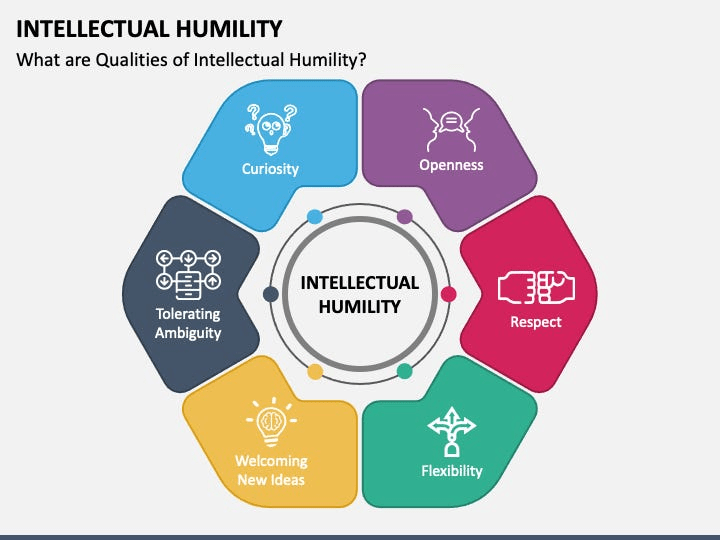
I liked this chart of the 6 dimensions of intellectual humility from the blog The Examined Family.
My Perspective
While I haven’t heard the term intellectual humility, I have heard of the concept.
I believe this is an area where many (including myself) need to be reminded of.
Personally, when someone is struggling with something, I want to lean in and share all my knowledge on the topic to help them in their situation. Leaning toward the stubborn side of the continuum.
I work diligently to ensure I’m understanding their perspective and view of the world.
My goal is to support, not dive in with intellectual overconfidence and the “right” answer.
The world is full of grey.
What is right for one person, might not be right for another.
Intellectual humility can help us get to win-win scenarios.
Your Turn
Were you familiar with the term intellectual humility?
Do you struggle to stay in the middle space between stubbornness & gullibility?
When you lean to one side, which is the most frequent for you?